More than 350 fellows have worked individually and collectively toward “creating a better South Carolina for all.” Clemson historian Otis Pickett is the fifth Clemson Liberty Fellow, and his charge is to help tackle some of the state’s most pressing challenges.
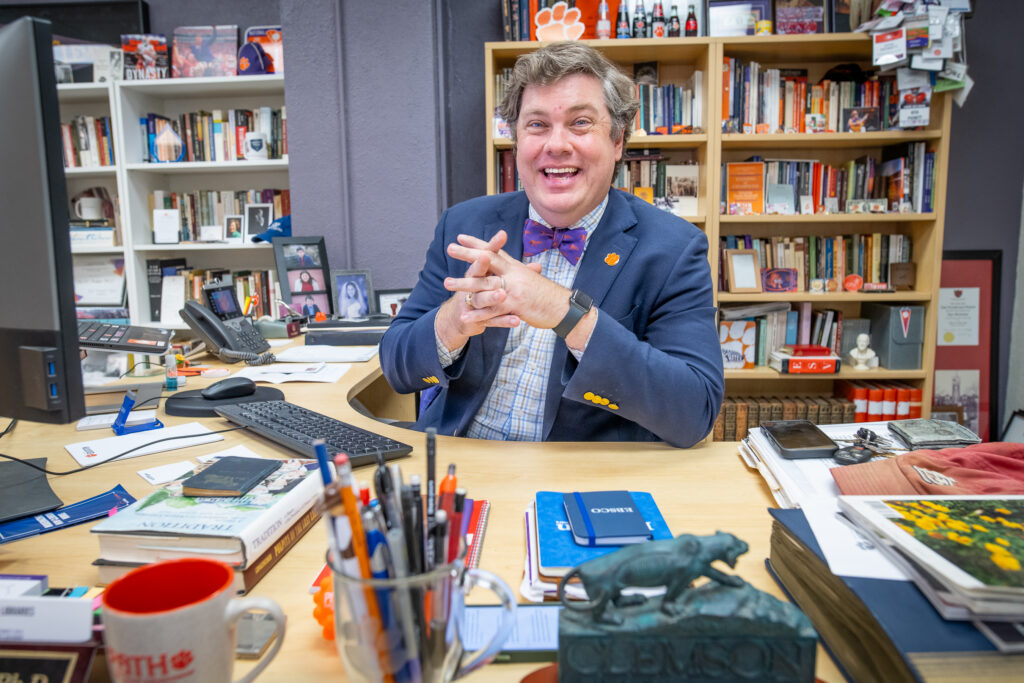
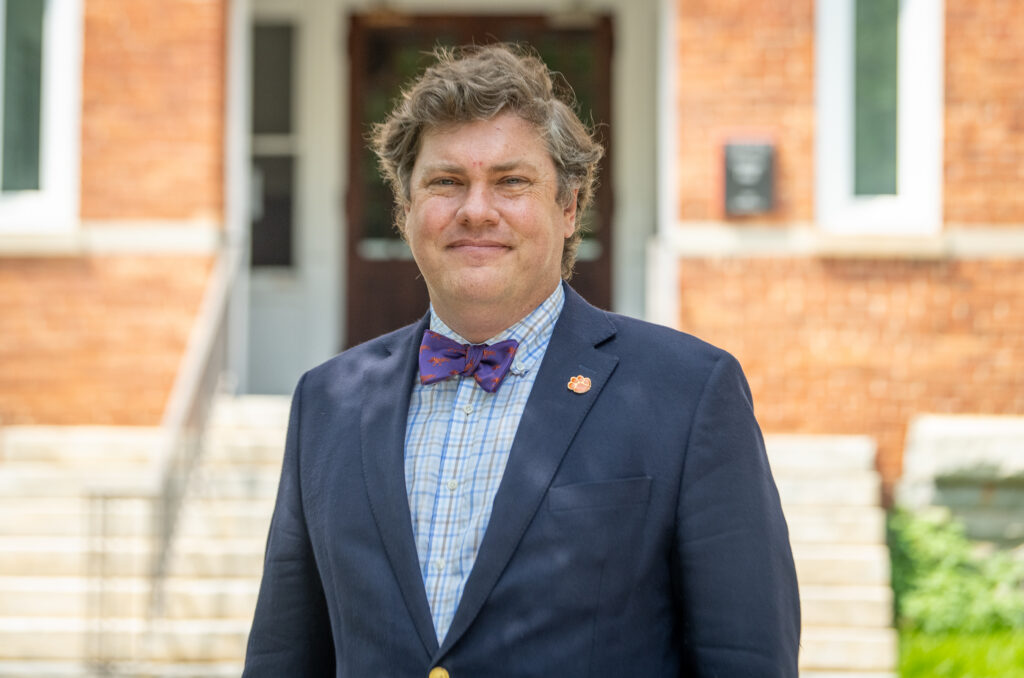
If you were a movie producer looking to cast someone for the role of cool college history professor, you might put out a casting call for someone just like Otis Westbrook Pickett. Tall, dressed in a dark suit jacket over an understated plaid shirt with his signature bowtie and a wisp of hair that resembles something between that of the professor in Back to the Future and Mark Twain — Pickett casts a singular silhouette on campus.
Also singular: His fiery enthusiasm for history, particularly Clemson history.
Pickett was recently announced as one of 21 Liberty Fellows selected from a pool of more than 600 applicants. He is the fifth person from Clemson to become a Liberty Fellow. Previous recipients are Windsor Westbrook Sherrill, provost distinguished professor of public health science and senior associate vice president for research; John Ballato, J.E. Sirrine Textile Foundation Endowed Chair of Optical Fiber; Craig Kinley, STRIDE program manager; and Clemson Trustee David E. Dukes.
The Liberty Fellowship is an intensive 18-month program founded in 2004 and shepherded by the Aspen Global Leadership Network that brings South Carolina leaders with differing worldviews together to tackle societal problems by challenging each other through civil discourse. Since the Fellowship’s founding, more than 350 fellows have worked individually and collectively toward “creating a better South Carolina for all” by establishing programs and initiatives that touch nearly every facet of the State including local governments, manufacturing, education, food distribution, healthcare and many others.
Growing new perspectives
A spark for learning about the past ignited in Pickett as a young boy growing up in Charleston, a city swimming in history, raised by two students of history: His father, Otis, who managed TV stations including WSPA in Greenville and Fox 24 in Charleston, and his mother, Martha, a schoolteacher.
“My mom was really passionate about racial healing work, so I learned that very young from her,” says Otis during an interview in his book-filled office in the R.M. Cooper Library. “That’s one reason why this fellowship really appealed to me, because they gather people from diverse political perspectives, racial perspectives and socioeconomic backgrounds and bring them together.”
His parents instilled a passion for history in him, but it was his grandfather, Robert Westbrook, a 1950 Clemson graduate and Korean War veteran, who planted Clemson in his heart. When he was very young, his grandfather would plunk him down next to him on the seat of his Lincoln Town Car and take him on road trips north to Clemson’s main campus.
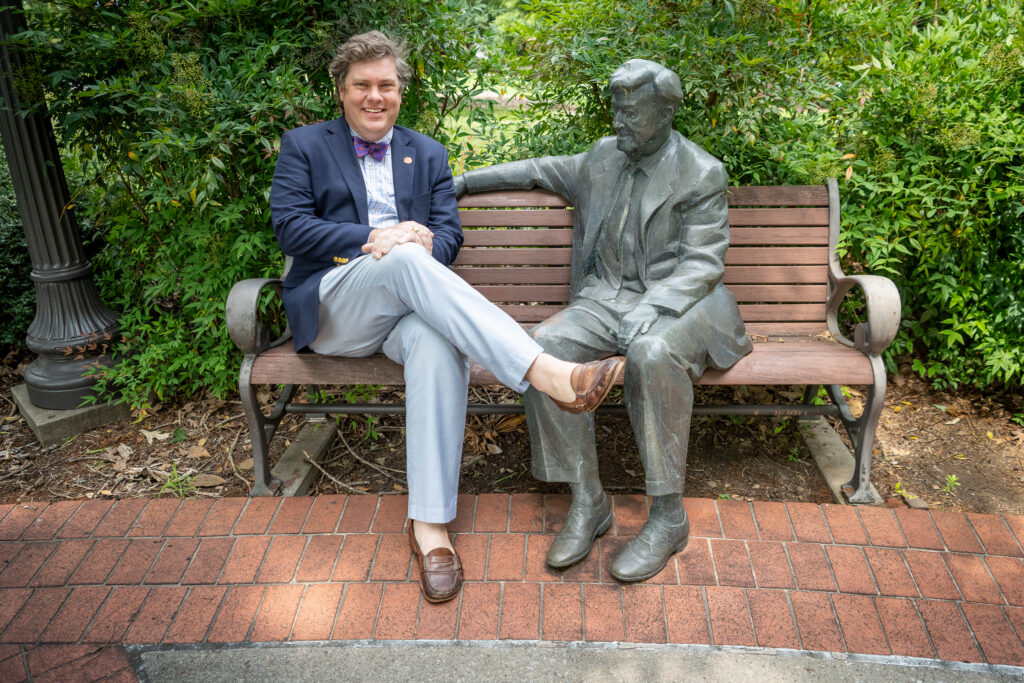
“As we drove up to Clemson, he would teach me all about South Carolina history,” Pickett recalls in a southern accent that gently broadcasts his Charleston roots.
“He was worried I was getting a Lowcountry-centered history, and he wanted me to know there were other places in the State. So, we’d ride through Fairfield County, we’d ride through Newberry, we’d go through Laurens, and he’d explain to me that the experiences of those people in the Upcountry, and in the backcountry, are different from those in the Lowcountry.”
A proud Clemson alumnus, Westbrook would fill his grandson’s ears with tales of his alma mater as the miles unspooled under their wheels. By the time they rolled onto campus, little Otis was hooked.
“He’d say, ‘Look — this is one of the best places in the State. This is the place that was built for the farmers, for the poor in South Carolina. It’s where you go to serve,’” says Pickett. “And I liked that notion, even as a little boy.”
A University historian
The spark turned into a fire and, by the time Pickett graduated from Bishop England High School in 1999, he was on his way to Tigertown. He graduated in 2003 with a bachelor’s in history with a minor in religion. He went on to earn a master’s degree in history from the College of Charleston and The Citadel in 2008 and a Ph.D. in history from the University of Mississippi in 2013. He was a professor at the University of Mississippi and Mississippi College before accepting a position as Clemson’s university historian in 2022.
It’s his dream job; at a place he loves that has a complicated past. He is uniquely suited to address those obstacles because of how he was raised and the woman who raised him.
“History doesn’t always make you feel better,” Pickett says. “It’s not always something that makes us say, ‘Go Clemson!’ But it can always be something that helps us understand who we were more fully, better appreciate where we’ve come from and learn from the missteps we made on the way.”
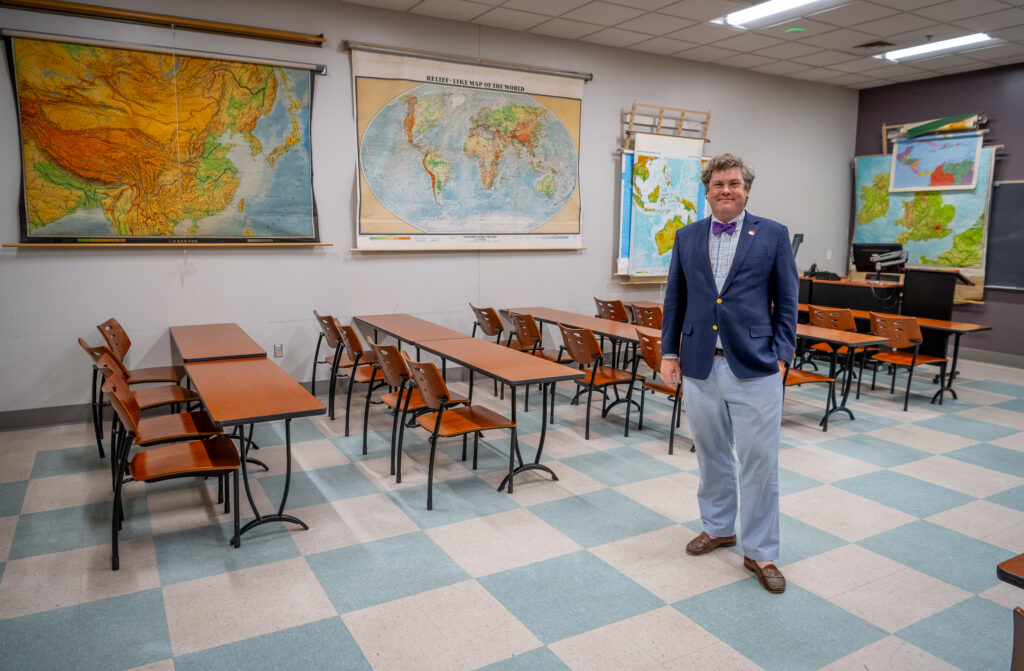
Pickett has made a name for himself through his research into religion in the U.S. South that focuses on enslaved African American and Native American communities, and the roles theology and ecclesiology played in shaping interracial interactions.
Sharer of stories
A walk across Clemson’s campus with Pickett reveals he might just be the perfect ambassador of the University’s past to the present. Every corner holds some significance or a memory for him, and he stops to chat with two prospective students and their parents, who are sitting in a golf cart. By the time they part ways, Clemson’s admissions office has two new submission packets on the way.

It’s that combination of pragmatism, empathy and thoughtfulness that made Pickett an ideal choice for the Liberty Fellowship, says Tycely Williams, the Liberty Fellowship’s chief executive officer.
“As an esteemed historian, Dr. Pickett brings a necessary lens and social understanding of how South Carolina’s past impacts and at times may impede our ability to drive collaboration across differences,” says Williams.
“We’re eager to promote Dr. Pickett’s scholarship on the global stage and to showcase how South Carolinians can learn from past transgressions to better actualize the equitable ideals and compassionate values of America.”
Pickett says this work has been on his mind for a very long time. When he was 11 years old, his cousin, Ian Merrill, an international studies major at the University of South Carolina, went to South Africa to help with the first elections after apartheid was abolished, and the stories he sent back made an indelible impression on him.
“He would write me letters from South Africa every week,” Pickett recalls. “He’d write about Nelson Mandela and what he was doing to change the country, and how they had a Truth and Reconciliation committee, the ‘truth’ meaning, how do you honestly walk through a history together as a society? That’s where you have to start. If you can’t honestly agree on the history, you can’t begin to repair the brokenness. And that’s very relevant to my work at Clemson.”
Fellowship in action
Now in its 18th year, the newest Liberty Fellows class will meet for a series of four, multi-day seminars in South Carolina and abroad starting in March 2027. Each fellow gets to choose one seminar overseas, and Pickett has selected South Africa, where he will study how race and segregation have affected society and how they are being addressed there.
In addition to attending four seminars in the United States and one abroad, each class member is required to create an impact venture that establishes positive change for future generations in South Carolina.
For his venture, Pickett plans to establish a prison-to-college program similar to the one he created during his tenure at the University of Mississippi.
Upon successful completion of the initial program, the Class of 2027 will join more than 350 leaders in the Liberty Fellowship South Carolina Network and 3,000 leaders in the Aspen Global Leadership Network. Through these two networks, they will have lifelong opportunities for engagement and access to an influential group of colleagues and mentors.
“The result will be a group of diverse leaders across the state who will all come to know and be just a phone call away from each other,” Pickett says. “We’re going to have some really hard conversations as a cohort, and the idea is that having been through those conversations, we’ll be able to help navigate difficult leadership dynamics together that will help move South Carolina forward, which, when I think about it, is really what I’ve been trying to do my whole life.”